In Australian classrooms the order of operations is often remembered as BODMAS or BIDMAS: Brackets, Orders (powers), Division and Multiplication, Addition and Subtraction. Calculators follow the same idea, but the details — negative signs, stacked powers, implied multiplication — are where different calculators can disagree. This page documents exactly what our engine does, so the scientific and graphing calculators always agree.
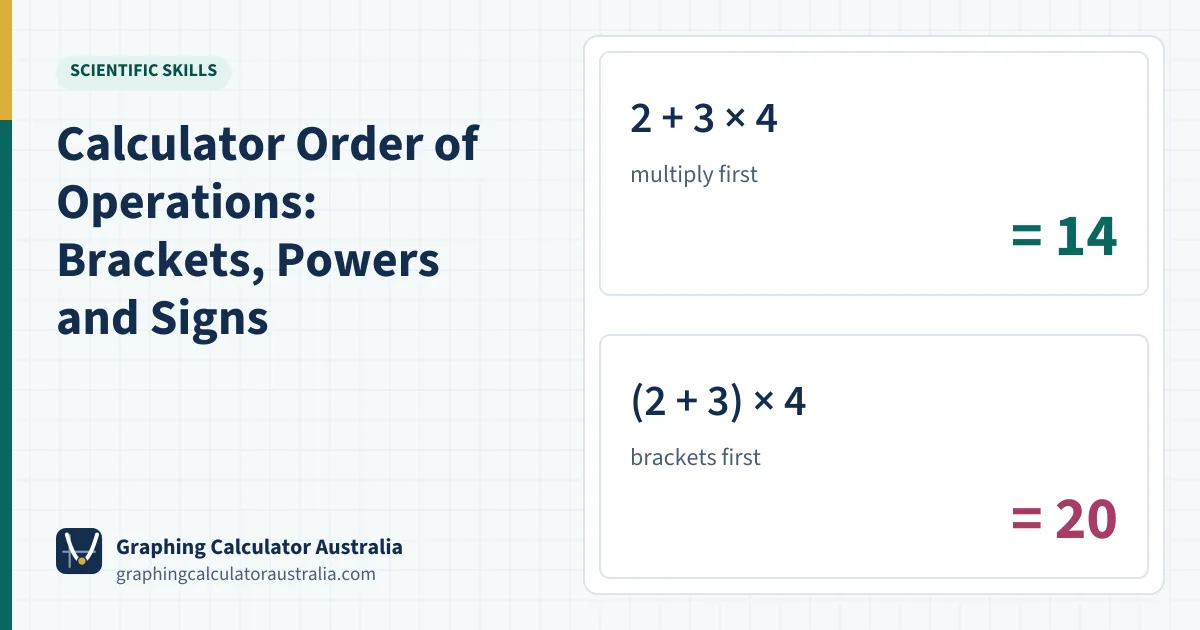
Two quick examples
2+3*4= 14. Multiplication happens before addition: 3 × 4 = 12, then 2 + 12.(2+3)*4= 20. Brackets first: 2 + 3 = 5, then 5 × 4.
The full order used on this site
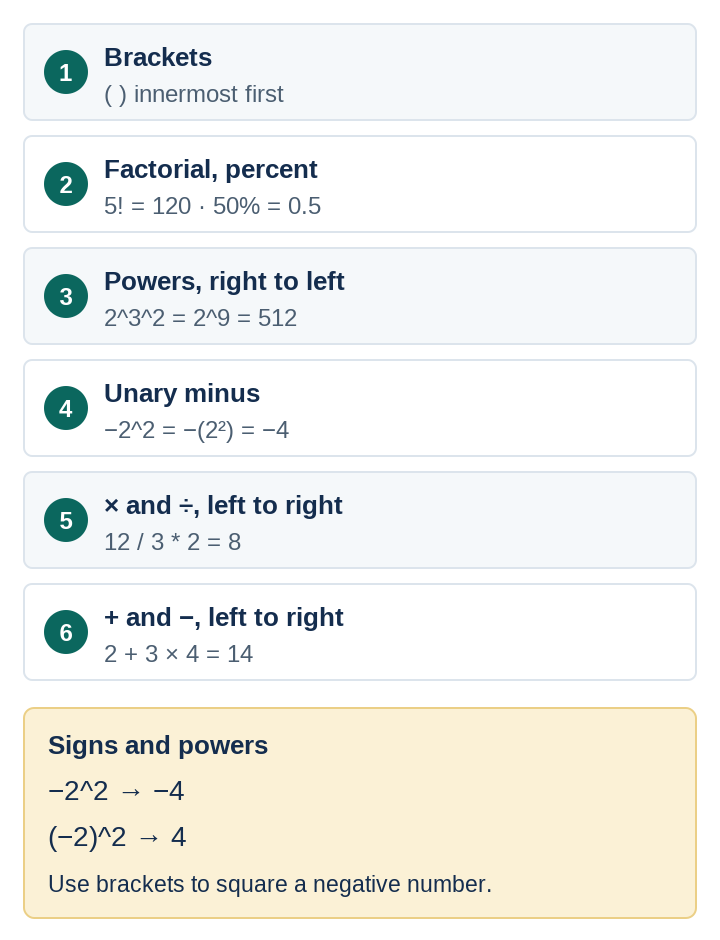
- Brackets — innermost first.
((1+2)*3)^2= 81. - Factorial ( ! ) and percent ( % ) — applied to the value just before them.
5!= 120,50%= 0.5. - Powers ( ^ ) — evaluated right to left:
2^3^2= 2^(3^2) = 2⁹ = 512, not 8² = 64. - Unary minus — a negative sign at the start of a term. It is applied after powers.
- Multiplication, division and implied multiplication — left to right.
12/3*2= 8. - Addition and subtraction — left to right.
10-4+1= 7.
Negative signs and powers
This is the rule that causes the most confusion:
-2^2means −(2²) = −4.(-2)^2means (−2) × (−2) = 4.
This matches standard mathematical notation: −2² is read as “the negative of two squared”. Many scientific calculators behave the same way, but not all, so get into the habit of using brackets whenever you square a negative number.
A minus sign after another operator is also fine: 2*-3 = −6 and 2^-1 = 0.5.
-x^2 is the upside-down parabola y = −x². If you want the square of −x, type (-x)^2 (which equals x²).Implied multiplication
You can leave out the × sign between a number and a letter, a number and a bracket, or two brackets: 2x, 3(x+1), (x+1)(x-1), 2pi.
Implied multiplication has the same priority as × and ÷ and is worked left to right. So 1/2x means (1/2) × x, not 1/(2x). If you mean 1/(2x), type the brackets: 1/(2x). Two numbers side by side, such as 2 3, are rejected as a missing operator.
Functions and brackets
Function inputs always need brackets: sqrt(9+16) = 5, whereas sqrt(9)+16 = 19. Powers apply to the whole function value: sin(x)^2 is (sin x)².
Checking your understanding
| Input | Working | Result |
|---|---|---|
8-2*3 | 8 − 6 | 2 |
(8-2)*3 | 6 × 3 | 18 |
2*3^2 | 2 × 9 | 18 |
(2*3)^2 | 6² | 36 |
-3^2 | −(3²) | −9 |
24/4/2 | (24 ÷ 4) ÷ 2 | 3 |
Practise with the calculator
Work out each answer by hand first, then check it in the scientific calculator. If your answer differs, write out the steps in the order shown above and find the step where you went a different way.
3+4*2^2— powers first (2² = 4), then 4 × 4 = 16, then 3 + 16 = 19.(3+4)*2^2— brackets first (7), then 2² = 4, then 7 × 4 = 28.-4^2+10— the power applies before the minus: −16 + 10 = −6.100/5/2— division left to right: 20 ÷ 2 = 10, not 100 ÷ 2.5.2(3+1)^2— brackets (4), power (16), then implied multiplication: 32.
Writing expressions from a textbook
Textbooks use fraction bars and superscripts that a single line of text cannot show. When you type them, add brackets for every grouping the layout implies:
- A fraction with a sum on top, (a + b) over c, becomes
(a+b)/c. - A fraction with a product underneath, 1 over 2x, becomes
1/(2x). - A power with an expression in it, 2 to the power x + 1, becomes
2^(x+1). - A square root over a sum becomes
sqrt(9+16).
Extra brackets never hurt: ((2+3)) is still 5. Missing brackets are the most common source of “wrong” calculator answers.
Common mistakes
- Assuming multiplication always comes before division. They share a level and go left to right.
- Forgetting that powers stack right to left.
- Typing a fraction like a/bc and expecting a/(bc).
- Squaring a negative without brackets.
Common questions
Why might another calculator give a different answer?
Calculators differ on edge cases such as implied multiplication and unary minus. Brackets make your intention unambiguous on every device.
Is “BODMAS” the same as “PEMDAS”?
Yes, apart from the words: Brackets/Parentheses and Orders/Exponents describe the same steps.
How this guide was made: drafted with AI assistance under the site’s editorial policy. Worked examples and plotted figures are computed by the same maths engine as our calculators and checked by automated tests. Found an error? Report a correction.