The most common trigonometry error on any calculator is not a maths mistake — it is the wrong mode. The same keystrokes, sin(30), give 0.5 in degree mode and about −0.988 in radian mode. Both answers are “correct” for what the calculator thinks you typed.
Two units for the same angle
- Degrees: a full turn is 360°. A right angle is 90°.
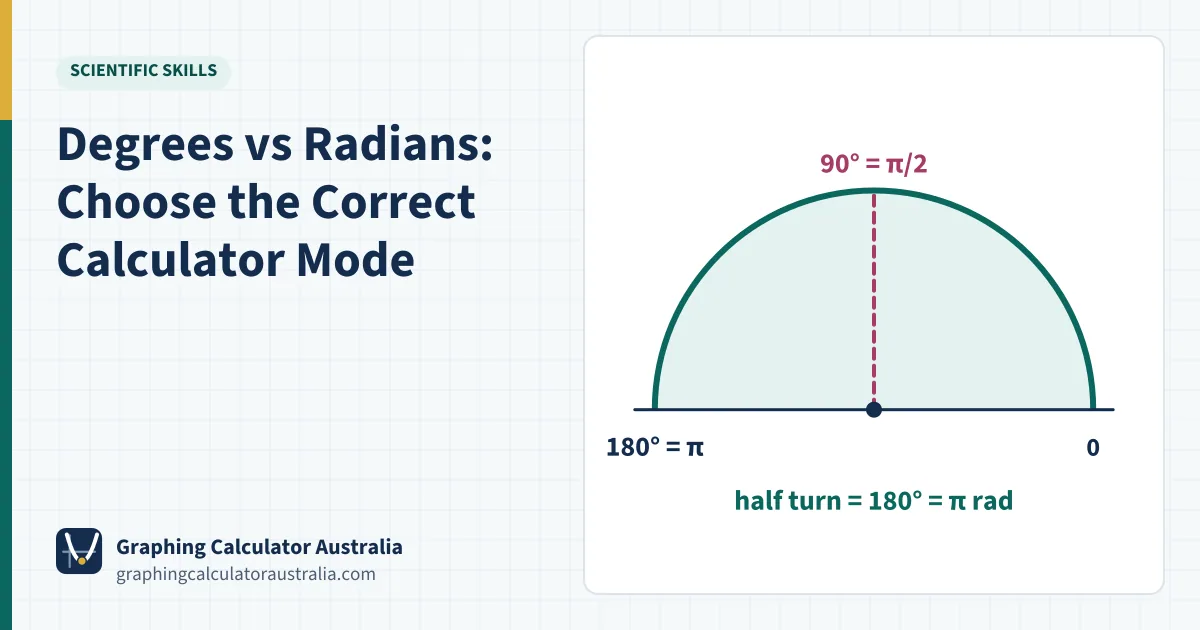
- Radians: an angle of 1 radian cuts off an arc equal to the radius. A full turn is 2π radians (about 6.283), so half a turn is π radians.
The key fact is:
180° = π radians
Converting
- Degrees to radians: multiply by π/180.
- Radians to degrees: multiply by 180/π.
Example: 30° × π/180 = π/6 ≈ 0.5236 radians.
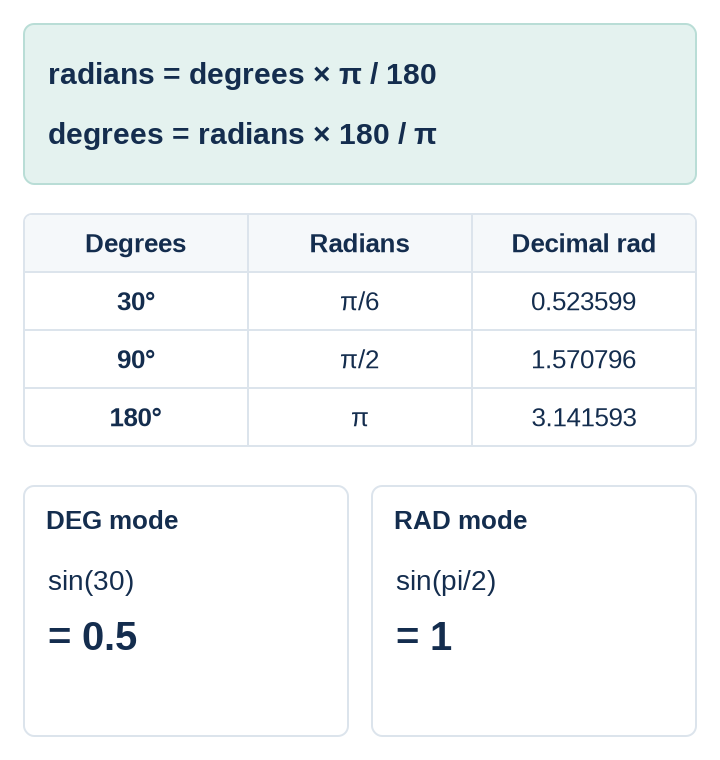
| Degrees | Radians (exact) | Radians (decimal) |
|---|---|---|
| 30° | π/6 | 0.523599 |
| 45° | π/4 | 0.785398 |
| 60° | π/3 | 1.047198 |
| 90° | π/2 | 1.570796 |
| 180° | π | 3.141593 |
| 360° | 2π | 6.283185 |
How the calculator interprets your input
In our calculators, the mode tells sin, cos and tan how to read their input, and tells asin, acos and atan which unit to give back:
- DEG:
sin(30)treats 30 as 30°, giving 0.5.asin(0.5)gives 30. - RAD:
sin(pi/2)treats π/2 as radians, giving 1.asin(0.5)gives about 0.523599 (which is π/6).
Other functions — powers, logs, square roots — ignore the mode.
Try sin(30) in degree mode → · Try sin(π/2) in radian mode →
Which mode should I use?
- The question shows a degree symbol (°), or angles like 30, 45, 90, 120: use DEG.
- Angles are written with π or as plain decimals in calculus or graph questions: usually RAD.
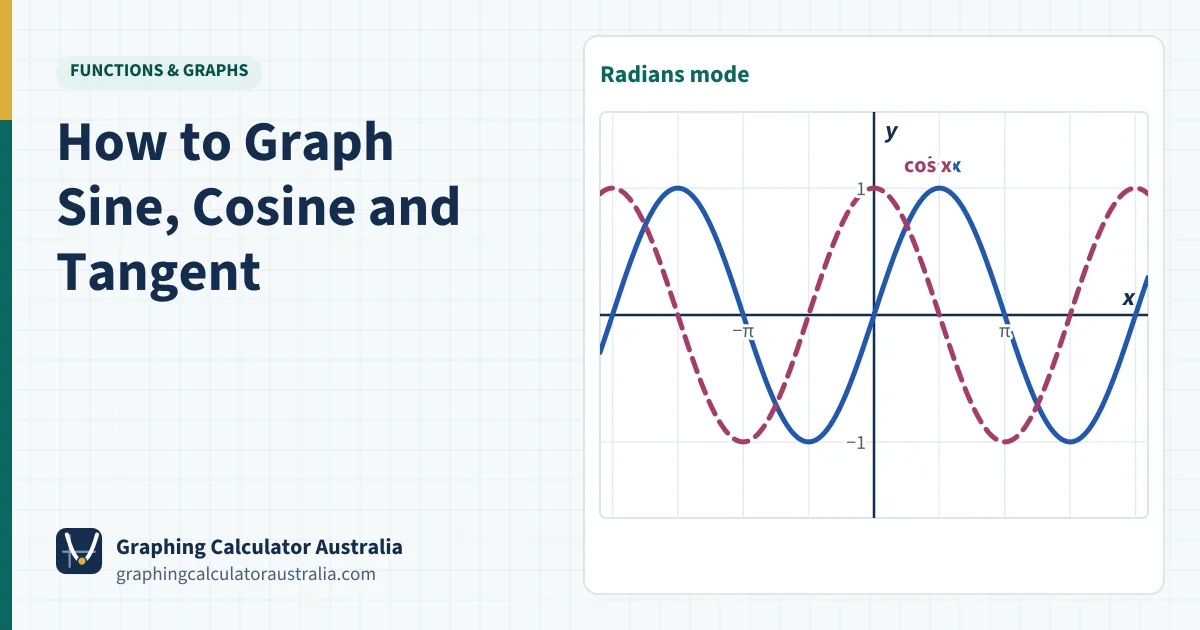
- Graphing y = sin x on a standard x-axis: RAD (one cycle is 2π ≈ 6.28 wide).
- Triangle and bearing problems in junior and middle-school maths: usually DEG.
When in doubt, compute a known value first: sin(90) should be 1 in degrees. If you get 0.894, you are in radians.
Converting on the calculator
You can let the calculator convert for you:
- In RAD mode,
sin(30*pi/180)gives 0.5 (30° converted to radians inside the bracket). - To convert 2 radians to degrees, type
2*180/pi≈ 114.591559.
Practise converting
Convert each angle, then check with the calculator.
- 45° to radians: 45 × π/180 = π/4 ≈ 0.785398. Check:
45*pi/180. - 120° to radians: 120 × π/180 = 2π/3 ≈ 2.094395.
- π/3 radians to degrees: (π/3) × 180/π = 60°. Check:
(pi/3)*180/pi. - 1 radian to degrees: 180/π ≈ 57.29578°.
A quick reasonableness check
Because π ≈ 3.14, angles in radians are usually small numbers: a full turn is only about 6.28. If a “radian” answer is 30 or 90, it is almost certainly in degrees. If a degree answer is 0.52 or 1.57, it is probably in radians.
Graphs and modes
On our graphing calculator the same mode switch applies to sin, cos and tan in plotted functions. In radians, one cycle of sin x is about 6.28 units wide; in degrees it is 360 units wide, so you must also widen the window. See how to graph sine, cosine and tangent.
Common mistakes
- Leaving the calculator in the last mode you used.
- Typing π in degree mode:
sin(pi)in DEG means sin(3.14…°) ≈ 0.0548, not 0. - Using a degree window (−10 to 10) on a degree-mode graph. Widen it to about ±360.
Common questions
Why do radians exist at all?
Radians make many formulas simpler, especially in calculus. For example, the arc length of a sector is rθ only when θ is in radians.
Is there a gradian mode?
No. Our calculators support degrees and radians only.
How this guide was made: drafted with AI assistance under the site’s editorial policy. Worked examples and plotted figures are computed by the same maths engine as our calculators and checked by automated tests. Found an error? Report a correction.